UNDER CONSTRUCTION — WORK IN PROGRESS
This page forms part of a developing public proof of concept. Content, structure and illustrations may change as the project develops.
WORK IN PROGRESS — PROOF OF CONCEPT
Rewiring the Public Sector
What happens when we apply experienced engineering thinking to government?
Public services are complex systems. Yet too often they are managed through fragmented information, disconnected responsibilities and weak feedback.
Rewiring the Public Sector explores what might change if disciplines familiar in engineering, manufacturing and safety-critical environments — verification, variance analysis, headroom, feedback and continuous improvement — were applied more deliberately to the design of public services.
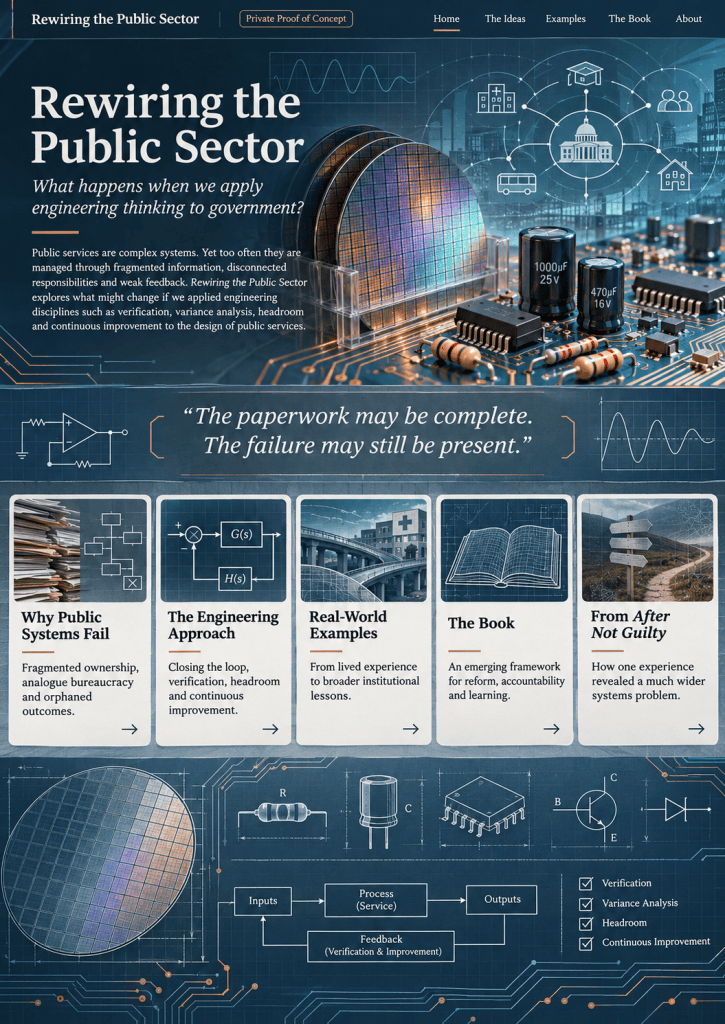
“The paperwork may be complete. The failure may still be present.”
The proposition
Government is not a machine. But complex human systems still require feedback, verification, learning, resilience and clear responsibility.
This project asks whether some of the disciplines routinely expected in engineering can help public organisations detect failure earlier, explain variance, preserve institutional memory and close the loop between action and outcome.
What makes this different?
Experienced engineering thinking. First principles. Real-world evidence. Closed-loop improvement.
Experienced engineering thinking
Practical lessons drawn from real systems, quality disciplines, verification, failure analysis and continuous improvement.
First principles, not management fashion
Start with what the system is meant to achieve, how information flows, where responsibility sits and how outcomes are checked.
Real-world evidence, not abstract theory
Practical examples expose recurring system failures and test whether proposed solutions would work beyond one case.
AI as an amplifier, not a substitute for judgement
Technology should strengthen memory, pattern recognition and analysis — not make flawed bureaucracy run faster.
First principles, not management fashion
Rewiring the Public Sector starts from first principles.
It does not begin with management theory, consultancy language or the latest organisational fashion.
It begins with simpler questions:
- What is the system actually supposed to achieve?
- What information does it need in order to work?
- Who is responsible for each stage?
- How do we know whether the intended outcome was actually achieved?
- What happens when reality differs from expectation?
- And how does that learning travel back through the system?
These are engineering questions before they are management questions.
The approach is therefore practical rather than doctrinal. It draws on experience of real systems, quality disciplines, failure analysis, verification and continuous improvement.
The aim is not to impose another layer of terminology on public services.
It is to strip problems back to their fundamentals — and rebuild from there.
Why Public Systems Fail
Fragmented ownership, analogue bureaucracy, disconnected records, weak feedback and orphaned outcomes.
The Engineering Approach
Closing the loop, verification, variance explanation, designing for headroom and continuous improvement.
Real-World Examples
Practical case studies used to identify wider institutional lessons rather than isolated failures.
The Book
An emerging framework for reform, accountability, resilience and organisational learning.
From After Not Guilty
How one experience exposed questions that reach far beyond one case or one institution.
Core engineering ideas
- Closing the Loop — a process is not complete merely because an action has been recorded; the outcome must be checked.
- Continuous Improvement — failure should generate learning, not merely correspondence.
- Independent Verification — systems should not depend entirely upon organisations assessing their own performance.
- Variance Explanation — when outcomes differ from expectation, the difference should be understood rather than simply recorded.
- Designing for Headroom — resilient systems require capacity for the unexpected.
- TIRR — a developing framework for testing whether information, responsibility and learning genuinely travel through an organisation.
- Augmented Thinking — using AI to strengthen human memory, analysis and pattern recognition without replacing human judgement.
A critical question
Are we automating good systems — or merely making flawed systems run faster?
Why this exists
Rewiring the Public Sector began with questions raised by one experience, but it has grown into a much broader examination of how institutions handle information, responsibility, failure and learning.
This private site is a proof of concept: a place to test the proposition, language, structure and visual identity before any public launch.

